What is a three-phase (3-phase) electromotor?
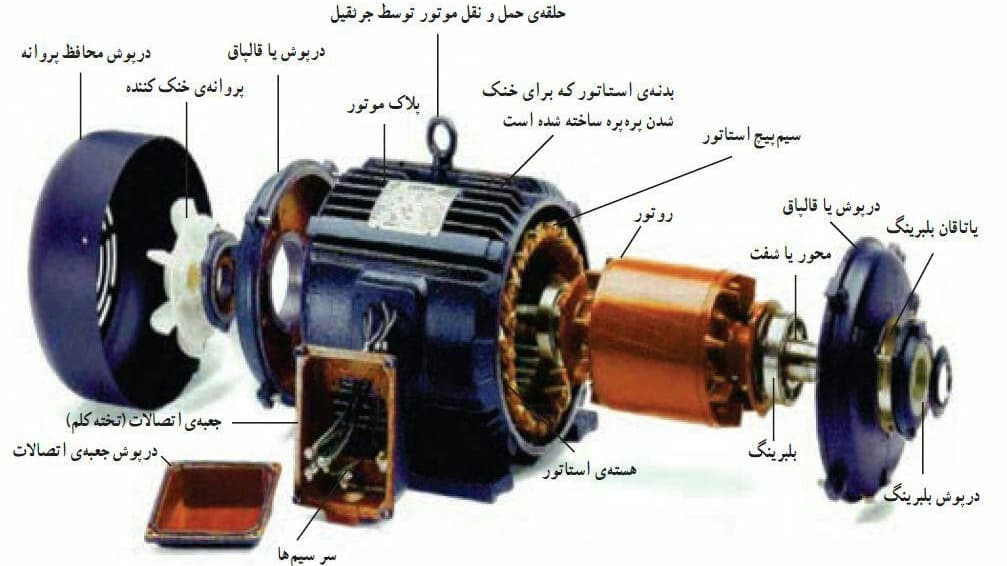
Stator
The stator consists of a series of layers of alloy steel that are wound around to form the induction coils, one coil for each phase of the power supply. The stator windings are powered by a three-phase power source.
Rotor
The rotor also contains induction coils and metal rods connected to form a circuit. The rotor surrounds the motor shaft and is the part of the motor that rotates to generate the mechanical energy of the motor.
Engine compartment
The motor housing holds the rotor with its motor axis on a set of bearings to reduce the friction of the rotating shaft. The housing has end caps that hold the bearing mounts and houses a fan that is attached to the motor shaft and rotates as the motor shaft rotates. The rotating fan draws ambient air from outside the housing and forces the air across the stator and rotor to cool the motor components and dissipate the heat generated in the various windings of the winding resistance. The enclosure also usually has raised mechanical fins on the outside that act to transfer more heat to the outside air. The end cap also provides a place to place the electrical connections for three-phase power to the motor.
How does a three -phase electromotor work?
Three-phase electric motors work on the principle of electromagnetic induction, which was discovered by the English physicist Michael Faraday in 1830. Faraday discovered that when a conductor such as a coil or loop of wire is placed in a changing magnetic field, an induced electromotive force, or EMF, is created in the conductor. He also observed that a current flowing in a conductor such as a wire creates a magnetic field, and as the current in the wire changes, the magnetic field changes.
For induction motors, when the stator is fed from a three-phase electrical power source, each coil creates a magnetic field whose poles (north or south) change their position as the AC current oscillates through a complete cycle. they change Since each of the three phases of the alternating current is phase-shifted by 120 degrees, the magnetic polarities of the three coils are not all the same at the same instant. This condition causes the stator to produce something called an RMF or rotating magnetic field. As the rotor is placed in the center of the stator windings, the changing magnetic field from the stator induces a current in the rotor windings, which in turn causes the rotor to generate an opposing magnetic field. The rotor field seeks to align its polarity with that of the stator field, resulting in a net torque being applied to the motor shaft, and when it tries to align its field, it begins to rotate. Note that in a 3-phase induction motor, there is no direct electrical connection to the rotor. Magnetic induction causes the motor to rotate.
With three-phase induction motors, the rotor seeks to maintain alignment with the stator RMF, but never achieves it, which is why induction motors are also called asynchronous motors. The phenomenon that causes the rotor speed to lag behind the RMF speed is known as slip, which is described as follows:
Synchronous electric motors work in a similar way to induction motors, except that in the case of motor Synchronous, the stator and rotor fields are locked in line so that the stator RMF causes the rotor to rotate at exactly the same rotational speed (synchronized); So the slip is equal to 0.
Motor controller for 3 phase electromotors
The speed produced by a three-phase AC motor is a function of the frequency of the AC source because the RMF source is in the stator windings. Therefore, some AC motor controllers control the speed of the motor by using the AC current input to produce a controlled frequency input to the motor. Another method that can be used to control the speed of the electric motor is to change the slip. If the slip increases, the motor speed (i.e. the rotor speed) decreases.